Showing posts with label fiction. Show all posts
Tuesday, April 28, 2015
Get in Trouble by Kelly Link
A beautifully crafted collection of short stories, Get in Trouble contained some of the weirdest stories I’ve ever read. Each one had a gorgeously portrayed mood that made them come to life one by one. The writing was unique, unlike anything I’ve read before. Though short (hence the short story part) each tale was magically woven as if Link herself lived in each one of the worlds she created.
The writing was the shinning star of this book. Although it was sometimes hard to get used to, once I got into it, I realized how natural it sounded. Most of the stories were written in a stream-of-conscious sort of writing, making it sound disjointed at times. However, I found that that kind of writing made it easier to connect with the characters, as it felt like I was in each one’s head.
The plots were sometimes straightforward, and sometimes subtle, all leading to one main point. It was the simplicity of the plots that allowed Link to go crazy with the world-building and setting. Each one sounded almost like it could be a part of the others, yet they also sounded entirely different. You dive right into the strange worlds without any kind of warning or explanations. They feel natural and real, despite the way they warped reality. Most of the stories were magical realism or sci-fi, but sometimes it was hard to separate the two. I think that’s an amazing thing for an author to be able to do, combine genres in a way that makes it stand out into its own genre.
With beautiful descriptions, the settings brought out such strange and wonderful tones to each story. They were heavy and solid, each one overwhelming the story. Some of them were creepy and haunting, while others were raw and emotional. Each one made me feel something, regardless of how much I enjoyed. Naturally, I liked some more than others, but none of these stories can I give a rating under four stars.
There was something about the mix of characters and the meanings of the stories, that truly shows how talented Kelly Link is. She could grasp things and put them into writing that most of us overlook. There is a strange kind of wisdom to this weird and beautiful book. It holds an endless amount of inspiration for me, and I wholeheartedly enjoyed and recommend it.
Thursday, April 9, 2015
Flowers in the Attic by V.C. Andrews
Beautifully told, Flowers in the Attic was a story that took my breath away. It held a haunting, quiet tone, with the perfect mood for such a story. The characters were strong, each with distinct personalities, and went through magnificent character growth, as did their relationships. The plot twist and betrayal took me completely by surprise.
This book was filled with so much emotion. I felt so angry at the mother the entire time, a growing hatred that left me shocked at the end. The relationship between Chris and Cathy, although wrong, came about naturally, and was very well done. The narration was lovely, doing a great job at expressing not only Cathy’s feelings and life, but also the lives of those around her. I felt that this book did an amazing job at showing how impressionable children, at any age, are.
It had a somewhat sickly feeling to it, which added to the mood and expressed perfectly the struggle the children went through. Although bittersweet, the ending tied everything up, leaving me feeling satisfied, despite the harshness of the book.
Wednesday, March 18, 2015
The Spiderwick Chronicles series by Holly Black and Tony DiTerlizzi
This middle-grade fantasy series wove together a beautiful story of magic and adventure. Split into five short chapter books, each book was its own little adventure, that combined into one whole story. This was a great series for both younger readers and adults alike.
Both the writing and the illustrations in these books were fantastic. The illustrations were honestly some of the best I’ve seen. They combined with the descriptions of the writing, to create gorgeous, nature-inspired creatures. The physical books themselves were lovely, and look beautiful on the shelf.
The world and creatures created were beautiful and realistic. The three main characters were great siblings, always working together and compromising, despite their major differences. Throughout the series, they find their strengths in order to defeat the evil creatures they are faced with.
Though each book was very short, and could have easily been made into one single novel, the stories were each satisfying to read. Although I flew through them, they are a great length for the younger readers they were created for. Some dark aspects were present in this series, making it unlike many middle-grade books, and adding a great deal to the world building. The settings and descriptions were very real and believable. The old book pages and paintings added to that.
Overall, this is a series that makes me want to go look for faeries in the woods, as silly as it sounds. It was a beautifully crafted set of books, one I’m so glad to have finally read, even though I didn’t get the chance to as a kid. It was fun, exciting and thrilling all at once, a series I will be glad to read to my future children.
Individual Ratings:
The Field Guide- Book 1
The Seeing Stone- Book 2
Lucinda's Secret- Book 3
The Ironwood Tree- Book 4
The Wrath of Mulgarath- Book 5
Series Rating:
Tuesday, March 17, 2015
City of Bones by Cassandra Clare
The action and adventure in this book was ongoing, while still leaving room for relationships to develop and a dash of humor to be thrown in. The plot was so intriguing, from beginning to end, making this a thrilling and fun read. There were many plot twists, betrayals, and moments of shock, most of which were not at all predictable. Because of its continuing excitement, I flew through this book, despite its size.
The writing was very nice, with beautiful descriptions and a mood that fit the story perfectly. I loved the settings, the combination of grimy abandoned places, and beautifully antiqued architecture. The writing was also very similar to author Holly Black’s, who I’ve heard is good friends with Cassandra Clare. Along with the writing style, the subject matter was also very similar Holly’s books. However, I honestly can’t complain, being that I love Holly’s books as well, and there are some clear differences between the two. If anything, their similar writing style was comforting and very enjoyable.
Something I found Clare does extremely well, is her characters and their relationships with one another. The relationship between Clary and Jace was a perfect example of a pair who doesn’t necessarily get along, but does have romantic interest in one another. The banter between them was funny and refreshing, without going over the top, like some awful book couples I’ve recently read (*cough* Obsidian *cough*). Not just those two, but all of the characters and their regards toward each other was genuine and real. The unrequited love was achingly good, and the friendship between unlikely people grew with this story. I truly loved all of the main characters.
While the world building was great, and many things were left open to continue to the next book, I was still slightly annoyed by the lack of resolution when it came to Valentine. After so many plot twists and secrets revealed, I felt like it lacked just one thing- Valentine’s side of the story. I’m sure this was a writing tactic, in order to continue with the series, so I hope it will be discovered in the next book.
City of Bones was an exciting, funny, and action-filled book. Its characters, setting and plot were all executed beautifully. I am so happy to have finally read it, and I cannot wait to keep reading this series. I highly recommend City of Bones to everyone. So good.
Monday, March 9, 2015
The Wind-Up Bird Chronicle by Haruki Murikami
Murikami’s writing has this strange dream-like quality to it that completely immerses the reader. Reading it is like entering not just a single world, but several parallel worlds at once. His books are weird in the best possible way, a perfect example of magical realism. The Wind-Up Bird Chronicle was a beautifully written and complex story.
While the characters are seemingly simple, they show their depth throughout the book. Each of them is strange and unique, playing crucial roles in the story. They tend to show up and vanish without any warning. However, this does not at all hinder the flow of the plot.
Beautiful writing, and character depth allow for stories to emerge within the original story of the book. This allows the story to grow and grow into this massive collection of characters’ lives. Yet still in the end, it is all wrapped up with amazing precision, giving a feeling of wholeness to the book.
Murakami’s intricate writing tends to emphasize the mundane, giving importance to small everyday tasks. While this is stunningly done, and gives the book a cozy, friendly feeling, sometimes it does tend to drag on for a bit too long. Despite this, I completely consumed this book, and plan on reading more of Murikami’s work in the future.
Sunday, February 15, 2015
The Book Thief by Markus Zusak
Despite the emphasis and importance of words that this book brings, I am at a lack for them right now, as I write this review. A page of notes hovers before me, and the book itself, still warm from my intent gaze, sits beside me. Still I can’t find the correct words to start this review. For me, such a book deserves more than this review can offer. Nonetheless, I want to share my opinion, so I suppose I should start by saying that The Book Thief was a nearly flawless story, one I can only wish I had picked up sooner.
Following a young girl named Liesel during Nazi Germany, this is a book about life, as told by Death. Instantly, this unique narrative captured me. I found the straight forward speech of the narrator fitting for such a story. It gave the writing a slightly broken feeling, which is very similar to the way people’s thoughts flow. With the use of colors, the beginning is able to convey such vivid descriptions in very few words. The writing never loses its potency as the story goes on. It is simply gorgeous, easily invoking an accurate mood and setting. Perfectly crafted metaphors add to this as well. The dialogue, though minimal, was also very potent and important.
Despite the starkness of the narration, despite the blatant foreshadowing told in flashes forward and back, it never takes away from the emotion and shock of what happens. The plot continues on at a constant speed. Even though we are interrupted many times along the way, the book reads quite quickly, while still giving the reader enough time to absorb everything.
The lovely and terrible snippets of Liesel’s childhood were woven together to portray a beautiful story of what is was like for her growing up during Nazi Germany. During this time, she forms strong relationships with several important people, who help sculpt her life. All of the characters were really pleasant to read about, each with their own strengths and weaknesses. One of them is her Papa, Hans Hubermann, who is a smart and gentle man that teaches Liesel how to read. He shows his strength throughout the story by constantly questioning the society he exists in, and taking risks to help others. The biggest risk he takes is by helping a young Jewish man named Max. While staying in the Hubermann’s house, Max and Liesel become close friends due to a common interest in reading and writing. Though Max has been through lots of hardship, an innocence and wisdom remains in him, which is shown through his illustrated stories. Along with her personal growth throughout the book, Liesel’s best friend Rudy also grows. During such a time, he is forced to grow up quickly, going from a carefree and wild boy to a caring and watchful young man. The growth of each character was subtle, shown through small, and large, acts throughout the story. Their choices and actions shaped who they became.
There is another relationship Liesel forms which is one of the most important aspects of the book- her relationship with books. From the start, Liesel’s interest in books gives the novel a warm, cozy feeling, which progresses as she learns how to read and steals more books. It inspires me to want to read more, to push the boundaries with writing, and to learn as much as possible. I also found Liesel’s feelings toward books and words very relatable, a sort of love hate relationship with them that I’m sure every reader has felt.
Though slightly dark at times, The Book Thief was a beautifully written book. The addition of Max’s illustrated stories gave the book a needed childlike quality, among its somber plot. With its unpredictable and emotional ending, this book will leave you yearning to keep reading it for much longer than it lasts. I loved everything about this novel, and will undoubtedly pick it up time and time again.
Sunday, February 8, 2015
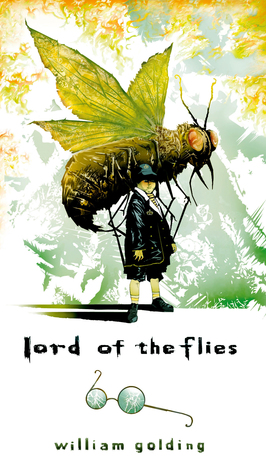
Lord of the Flies by William Golding
This book delivered exactly what I expected it to. It is a rather simple story featuring a group of schoolboys whose plane crashes on a deserted island. There, they must survive, first against the struggles of being on the island, and soon against each other. Holding an atmosphere of thick, dripping heat, and untamed jungle, I could easily feel the setting in which the story takes place.
Though this story is caked in symbolism and themes, there is one that stands out above the rest. The decline of the sanity and sensibleness of the characters, as they’re overwhelmed with freedom and lack of order. As children, it is easier for them to revert back to primitive ways, which is shown increasingly throughout the book. The character Piggy, who is a symbol of wisdom and common sense, is just about the only thing allowing some sense of law within the group.
The decline of the group’s order was beautifully shown as this short but potent novel progressed. Just as well, the immense imagery made the setting of the island seem very real. The characters portrayed a variety of mental states, all of which are greatly effected throughout this novel. Though a story simple enough to be read by nearly anyone, its dark undertones and shocking themes made it a hearty and complex read.
Monday, October 13, 2014
Goddess of the Night by Lynne Ewing
I first started reading this series back in middle school and was completely engulfed in the witchy world of the characters. I was lucky enough to find books 1-9 at Goodwill several months ago, and now I’ve decided to reread them to see how I like them now.
The first book of the Daughters of the Moon series was a really fun and quick read. I read it mostly at night, which emphasized the slight creepiness of when Vanessa, the main character, was being followed. The writing was pretty juvenile, including a lot of short, simple sentences. However, when there was description, it was more enjoyable, especially when the girl’s powers were being explained.
The overall storyline was extremely predictable. It is easy to see from the beginning who the bad guy is going to be. The characters were definitely underdeveloped. Vanessa, despite being popular and cool, is a regular, boring girl, with no back story and hardly any personality. The others, though they had a bit more personality, still did not seem very believable. Each character just seemed to be contained of a different cliche high school group.
The way the characters meet was unrealistic. Vanessa acts like Serena is her friend almost instantly, when all she did was go over her house for a psychic reading. They become friends without ever really being friends. Also, the relationship between Vanessa and Michael is very forced. Despite Vanessa telling the reader that she has always liked Michael and that they apparently had something going before the start of the book, it still seemed to develop unnaturally, and there is no concrete reason given as to why Vanessa even likes Michael. Also I like how the character of Stanton developed throughout the story, even though he rarely appeared.
So there were a lot of things wrong with this book, but fortunately, those faults didn’t stop me from liking it. I am a sucker for girls with magic powers, and the lore behind them, especially moon driven powers. Though it is only touched upon in this book, through the character Maggie, I love the Greek mythology aspect of their magic, as well.
I also really liked how Vanessa didn’t take any sexist shit. That’s something I did not notice the first time reading this, but finding them this second time made me appreciate this book even more.
There was definitely a bit of nostalgia going on for me while I was reading this book, which is perhaps why I liked it more than I should have. Regardless, if you are willing to overlook this book’s flaws, it’s worth a read. I definitely recommend it for a younger audience, like middle schoolers. With it’s subtle basis in Greek mythology, and slight feminist undertone, I think this is a great book for young girls. I will be continuing the series, and I’m excited to see if there is any character development.
Sunday, June 1, 2014
Monstrous Beauty by Elizabeth Fama
Alternating between the 1800’s and the present, Monstrous Beauty is a dark mermaid story about love and family. It is woven together with beautiful, elegant writing, the entire book holding a pleasant, calming feel. This is the kind of story that I used to dream about as a kid on our vacations to the ocean.
Though not the most exciting plot, it flows very well between the point of view of Hester, a girl trying to figure out her ancestral history, and Syrenka, a mermaid trying to live a human life, back in the 1800’s. Throughout the story, their connection is discovered, as Hester researches and Syrenka comes upon troubles in her life. There is a bit of a mystery aspect of it for Hester, but we learn things before she does through the narration.
The mermaids of this story, which is what I was drawn to, were creepy and dark. Along with the addition of ghosts and graveyards, it was perfectly eery, while still holding the air of a touristy seaside town. The characters helped accentuate the mood and feeling of the story, which was very refreshing.
Hester was a pretty good main character. She was easily relatable and likable. As a person, she is smart, driven and logical. She thinks things through, without making rash decisions, and knows what is important in her life- which is her family, and friend Peter.
Though somewhat predictable, this story was still very enjoyable. There were a few twists near the end, which spiced it up a bit. Hester’s encounter with the mermaids was unexpected and strange, but a pleasant addition to the story. A simple summer read, this was a nice books about not only mermaids, but love, history and family.
Monday, May 26, 2014
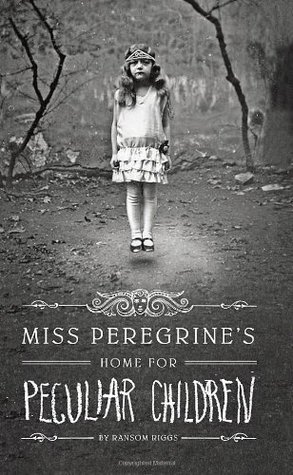
Miss Peregrine's Home for Peculiar Children by Ransom Riggs
I was initially drawn to this book by both its cover and title. I hoped for something creepy and mysterious, which is what this book turned out to be. The inclusion of the old photographs was brilliant, adding a very important mood to the story. It was a very fun adventure, best read on a grey, rainy day or at night.
The main character, Jacob, was a pretty average teenage boy, living in Florida with his semi-rich parents and the strange stories his grandfather has told him all his life. But with the mysterious death of his grandfather, he goes on an adventure to discover that the stories might have been true after all. Accompanied by actual vintage photograph, the story is one with a very strong mood and striking plot.
Jacob’s character was nothing spectacular. He bothered me toward the beginning, being somewhat spoiled and dull. Even throughout the book, as he grew ever so slightly, his personality remained unembellished and rather passive. While that didn’t help me at liking his character, it did make room for the story to grow. Had his personality been too strong, it would have overpowered the story. While his personality was tolerable, one thing I would have changed about him was his age. Throughout the story, I imagined him being a few years younger, 14 perhaps. For going on such an adventure, a slightly younger age seemed appropriate. Nonetheless, his narration told the story really well.
I did not like his parents much, although his dad was at least portrayed as a real person, with faults and such. The children at the school were great. Each had distinct personalities, but they worked great together, which was fun reading about. I thought the relationship between Emma and Jacob was a bit fast and shallow, but I suppose it was portrayed that way on purpose, and I can’t wait to see how it grows in the next book.
Along with the exciting plot, the setting was one of my favorite things about this book. The image of the tiny island and seaside town was so strong. The weather matched perfectly with it, which is why I enjoyed reading this book especially on rainy days. The different times were also explained nicely, making it seem real, and almost normal for Jacob to be going back and forth between the loop. The idea of the loops themselves seemed quite realistic, emphasized through the setting of the island. I also really liked the dialogue of the children, and even of the people of the island in the present day.
The photographs within the book also made it so much more interesting and engaging. I really appreciated how they helped sculpt the story, and the characters. Also, upon reading the third to last page in the book, it is explained that the photographs are in fact real, several with slight alterations, collected by people who search for them and save them in personal archives. I’ve once heard of people doing this, and I find it so inspiring, like collecting memories and histories of people we’ll never know. And the idea of using them in this story is absolutely stunning. Like giving life to something that would otherwise be overlooked.
This story was a great adventure, with a perfect setting and interesting backstory. While the main character lacked depth, the other characters made up for it. The ending was also perfect, a great cliffhanger that makes me excited to read the next book, but also a bit of closure, involving Jacob’s dad. The story was just a bit creepy, with some history thrown in, and a strong mood that emanates from both the story itself and the actual book. I am pumped to see where this story goes, and what adventure the children go on next.
Tuesday, May 20, 2014
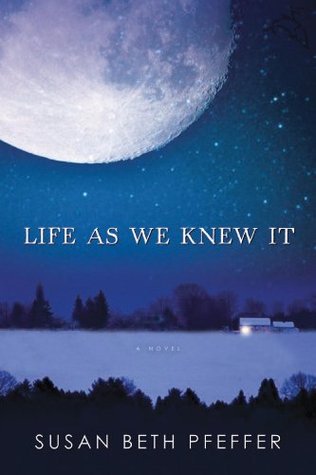
Life As We Knew It by Susan Beth Pfeffer
Life As We Knew It is a fantastic end-of-the-world YA story. Told through the diary of a girl name Miranda, the simplistic style of writing is easily translatable to a younger audience. However, that doesn’t take away from it’s highly realistic plot, and believable characters. It thoroughly brings to question what could happen if something like this were to become a reality.
The plot and setting in the book are much more ‘down-to-earth’ than typical YA dystopians. Instead of something astronomically unrealistic happening, something as simple as an astroid hitting the moon occurs. Yet it creates devastating problems when the moon is knocked off its orbit. From that, everything goes downhill. However, instead of the family going on some dangerous adventure, they stay put and have to face the struggles of living without electricity, water, and heat, surrounded by death and illness. The writing makes it easy to imagine the neighborhood as your own neighborhood, and the family as your own family.
Through Miranda, the (mostly) neutral voice in the story, we are shown a variety of different characters and how they handle such a situation. All of the characters are put to the test in this novel, turning stereotypical Mary Janes into real, relatable people. The character growth and development comes so naturally. Each of the characters deals with the situation in their own ways. Some handle it better than others, some take more time, just as in real life. The growth of Miranda in particular is very impressive. Like a real person she struggles with the situations she is faced with. As she progresses through the book, she falls back several times. She has her weaknesses, which hinder her at first, but in the end, help her grow as a person.
Despite the difficult, life-changing problems the characters face in this book, it is not a very deep, dark story. To some, this might be bad thing, but for me, it was perfectly executed from the point of view of an inexperienced teen girl. It touches on many of the things average teen girls face, like prom, and school, and boys, but it isn’t so doused in those things that we lose a sense of character. In this story, family, health, happiness, and survival rule over those stereotypical things, which made Miranda a very believable character.
This story, with it’s simple premise that most end-of-the-world type YA books tend to overkill, was practical and plausible. Its characters were given strong voices and imaginable personalities. The writing was comprehensible and easy, without losing its potency. This was a book that I’ve read before, and will continue to pick up many times in the future. I most definitely recommend it.
Sunday, May 11, 2014
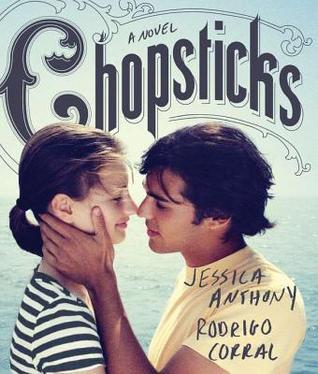
Chopsticks by Jessica Anthony and Rodrigo Corral
Told exclusively through photographs, IMs, postcards, and other ephemera, this sweet and easy read will leave you feeling something in the short amount of time it takes you to read it.
The story follows Glory, who, after the death of her mother, becomes obsessed with music. She later meets Francisco, a boy from Argentina, and they embark on a relationship full of difficult decisions.
The usage of pictures to tell this story was absolutely beautiful. With its rather bleak beginning, the story could have ended in any combination of ways, and I did not expect it to end the way it did. However, it was so amazing, a bit of closure that made my heart ache. The symbolism in this book was also very sweet, especially the way Chopsticks relates to the relationship between the two main characters.
I was stunned at how powerful a story comprised solely of pictures could be. It took me about an hour to read and absorb the beautiful photography, as well as its various meanings. But I feel like this story will stick with me long after. Not only was this a graciously put together book, but a gorgeous story about love and life. I really adore and recommend it.
Monday, May 5, 2014
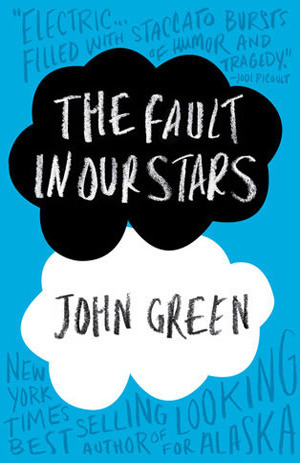
The Fault in Our Stars by John Green
(Note: This a very personal review, and it was necessary to mention certain parts of the story in it. I tried to keep it as spoiler free as possible, but if you know nothing about this book, I suggest you wait until you’ve read it, to read my review.)
To be honest, it took me a long time to pick this book up because I was afraid of how it would affect me. I have read other books dealing with mental illness/love that left me feeling depressed, for various reasons, but usually because the characters were so relatable that I’d start comparing my life to theirs. That is my excuse as to why I avoided this book I’ve heard so many good things about, for so long, why I was literally afraid to read this book.
But I have now read it, and I have a lot of things to say about it.
I finally decided to read this book for some unconscious reason. I was feeling brave, and it seemed to nag me from the shelf. It was somehow what I expected, and not what I expected at the same time. The story, which was fairly simple, was super easy to get into, and I finished it in about three days. The same night I finished it, I started it over again.
I was, once again, blown away by John Green’s writing. It was very fluid and real, like a person’s direct thoughts captured on the page, which is why it was so easy to read. For the most part, I’d say he has an amazing ability to write teenagers. However, the writing was not quite flawless. It’s going great, perfect, until Augustus is introduced. Hazel is instantly captured by him because he’s sooo hot. Because like a stereotypical teenage girl, the first thing she notices about him is whether or not he’s hot. It’s not creepy at all that he’s staring at her, and she justifies this by saying how inappropriate it would be if he were not hot. “But a hot boy...well.” It does not seem very realistic, especially the instant change in writing that takes place while Hazel talks about this hot boy. Luckily, after they become friends and then date, the writing does not break into these unnecessary gushes again.
Now, onto the characters.
As a defiant, outcast teenager, I think I would have appreciated the sarcastic and comically pretentious characters a bit more. They are, essentially, the too-cool-to-like-what’s-cool type of teenagers that I unfortunately once was myself, which can be summed up in this line: “I take quite a lot pride in not knowing what’s cool,” I answered. The dialogue between Hazel and Augustus was entertaining at times, and admirable at others. They spoke unlike average teenagers, and it was clear that while it seemed to come easy to Hazel, I could imagine Augustus spending many years mastering the art of metaphoric speaking. They did not talk like typical teenagers, but then again, they were not typical teenagers. Being surrounded by and faced with death forced them to become wise, despite the fact that they are still kids. Augustus was a little over the top, with his unsmoked cigarettes and soliloquies. It’s difficult to imagine a real boy acting how he does.
While Hazel grew on me, both her and Augustus being so purposefully pretentious and insensitive was the biggest downfall of this book. At first I couldn’t understand why Hazel fell so quickly for Augustus, after he explained his overwhelming love of metaphors. Hazel seemed to me like the kind of girl who would avoid someone like Augustus; I imagined she’d resist his slightly conceded demeanor. But I soon realized that she was just like him, and the two of them went together well, despite their obvious faults, or even because of their obvious faults.
Peter Van Houten, the author of Hazel’s favorite book An Imperial Affliction, is sort of an adult version of Augustus and Hazel, but lacking the maturity. In his letters to Hazel and Augustus, he uses highly impressive language, but his fake invitation to them to come to Amsterdam proves that he’s not the amazing person he tries to get people to imagine. He bothered me more than Augustus and Hazel combined.
It was quite refreshing to read about how involved Hazel’s parents were. They weren’t just there or non-important, like in so many YA books. They were present in the story, as strong, believable characters. They were flawed, as people are, but they weren’t cast as annoying or in the way, by Hazel. I enjoyed finding out about how much Hazel’s dad cries, and how strong her mom is. Come to think of it, Hazel’s mom was probably one of the best characters in the story. She was realistic and believable. She went on the trip with Hazel and Augustus, which I can imagine, if written by someone else, she wouldn’t have gone, which would make it more ‘romantic’, but lessen its believability.
The plot of this book was fairly simple, the flow of a growing romance, with reminders of Hazel’s cancer throughout. It was very enjoyable, though somewhat predictable. One thing I would have liked to see is the connection between Hazel’s affinity to America’s Next Top Model and their trip to Amsterdam. I know this is a trivial addition, but anyone who watches ANTM probably envied the models’ trip to Amsterdam, and I wished that Hazel had mentioned it, if only to make the whole thing more believable. But surely John Green does not watch the show, so…
This was a book that made me feel, but not in such a brutal way that I regret reading it. The relationship between Hazel and Augustus, but specifically Hazel’s loss of him, made me realize how lucky I am to have someone in my life that is as special to me (except more) as Augustus was to Hazel. It made me appreciate that we have the future to look forward to, even though right now things aren’t perfect. It made me feel blessed to have him, and a loving, although far from perfect, family.
This book made me feel, not not just toward the characters, but translated in my life. It is so powerful when a story can do that, especially one so easy to read. I was again stunned by John Green’s ability to capture such emotions through simple characters and unembellished writing. This was not only an amazing YA novel, but a book anyone can read and understand the message of. Though this book and its characters are not for everyone, those who want to give it a read will be hit hard with lots of emotions that will sink in slowly over time. Which is why, by the time I finished reading it, I wanted to start it again.
Monday, April 21, 2014
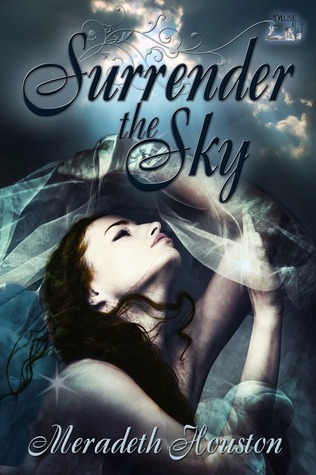
Surrender the Sky by Meradeth Houston
*I was given this book by the author in exchange for an honest review.*
Following Gabby, an angel-like creature called a Sary, this story is a decent YA read. Although it ended up being not quite my cup of tea, I was able to get through it pretty quickly. On personal opinion, I am giving it 2 stars because it didn’t capture me the way I had hoped. I felt no emotional connection toward the characters. However, as a light, paranormal teen read, I am giving it 3 stars. I think a different reader would appreciate this story a lot more than me.
I love the idea of the Sary. Essentially, these winged people’s sole purpose is to save suicidal humans from killing themselves. It’s very unique, and I really enjoyed how the positives and negatives of being a Sary are explained throughout the story. However, the rules of being a Sary were not very clear, especially the rules about love, which took away from the impact of the story.
The writing was quite good, especially when Gabby’s blunt way of thinking didn’t interfere. It has a really great combination of description and dialogue, not over or under doing it at any point. The beginning was very quick and exciting, a great way to start the story. The first few lines drew me in instantly.
Gabby is very much like a teenager, despite actually being decades old. Her way of thinking is very frank and sarcastic, which hurt the narration, in my opinion. She is also, at times, quite childish and bratty. There wasn’t much character development throughout the story with any of the characters, but especially with Gabby. She remains confused about what to do most of the time. Also, in the beginning, it doesn’t seem like she makes much of an effort to save Chad, which is her sole job.
As expected, there was a bit of insta-love between Gabby and Jassen, as well as Nathan and Bree. However, it was bearable. The relationship Gabby and Jassen have, seems more like an unrequited crush at first, and it takes a while for anything serious to happen, which was good, at least.
Overall, this was a nice story. Being a YA book, it is definitely meant for teens, in my opinion. There wasn’t much depth to the characters, but the plot was enjoyable, and the writing was very good.
Monday, March 31, 2014
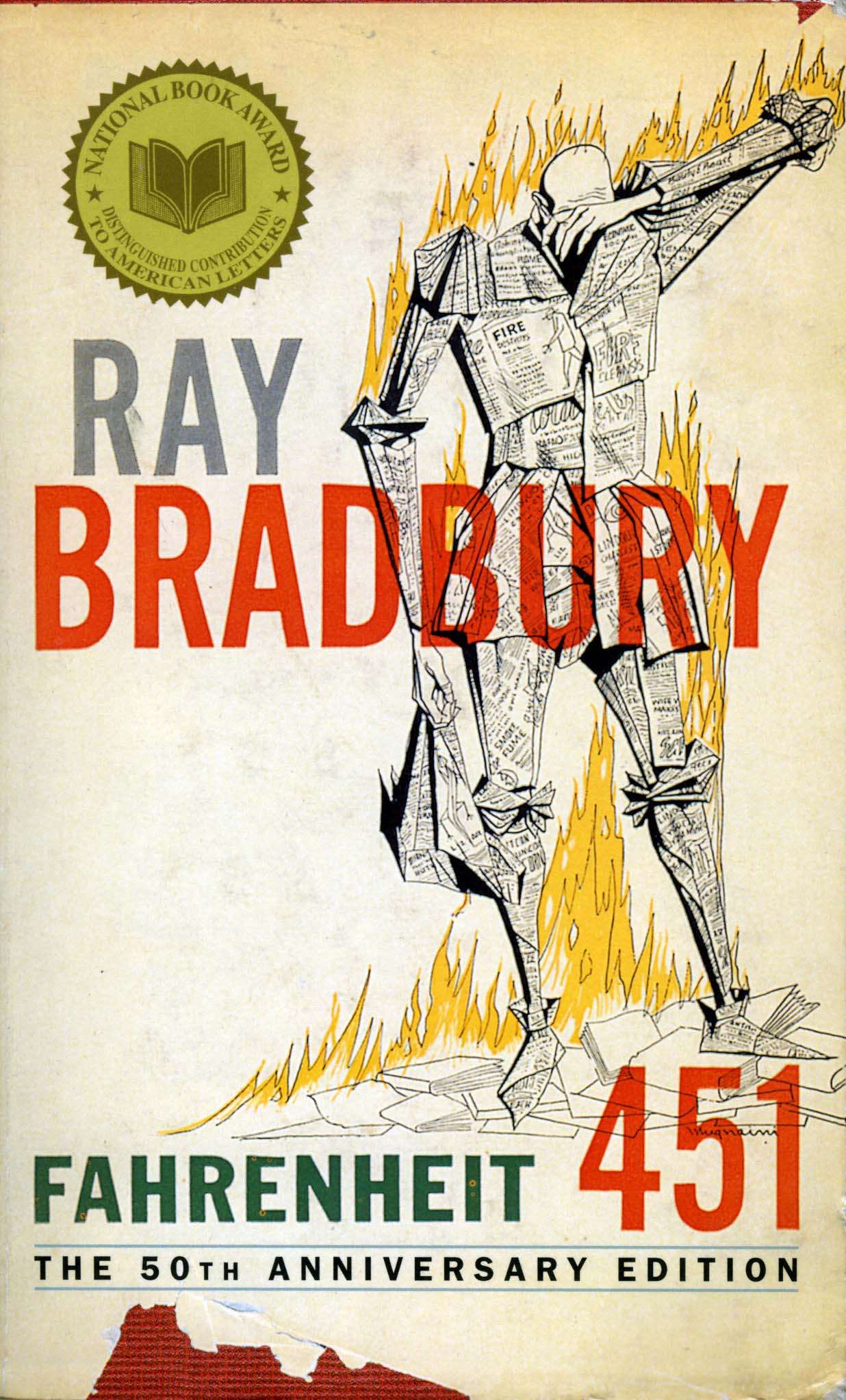
Fahrenheit 451 by Ray Bradbury
Aside from Bradbury’s stunning ability to portray a realistic future, one which is strikingly similar to the age we’re living in now, the most beautiful aspect of this book, in my opinion, is mood it emits. A mood that returned to me four years after reading this book, to haunt my sleep and make me want to pick it up again.
Shown through Bradbury’s expressive writing style, this book starts off with an eerie dream-like feel to it. The repetitiveness is used to emphasize people’s lack of original thought in a world where it is practically illegal to think for yourself. But as the protagonist, Guy Montag, starts thinking for himself, the writing itself changes, becoming more descriptive and emotional, as Montag enters an awakening. Through this change, the changing mood is also exposed.
The main part of the book made me feel heavy and sick, as Bradbury describes how this future is- a world where people are constantly plugged into their electronics, much like how it is today. And because it is so similar in that sense, it’s not hard to imagine our world slowly changing into one of no emotion and no intellect, where sports are the only thing prized in school, and entertainment comes before everything else, where family means nothing and ‘happiness’ and conformity mean everything.
However, there is hope in this dreary future. Montag’s discovery of some of the world’s remaining intellects sparked me with the idea of possibility, and a renewed faith in humanity. The idea of writers and books living on through their readers was shocking to me at first, until I realized that it so true to how it is today. Through reading, we’re not only carrying on the stories, but we’re incorporating them into our lives and thoughts so that we can grow as individuals.
While reading this part, it suddenly made me want to go outside in barefeet and feel the mud between my toes. It made me want to smell the rain and listen to the silence between the noise. And most importantly, it made me want to read every book I could get my hands on.
I could say so much more about this book, aside from just emphasizing the importance of the mood. Instead, I think it’s important for you to read it and form your own opinions on it. I recommend it to absolutely every reader, and any person who is willing to give it a try.
Sunday, March 23, 2014
Frey by Melissa Wright
This is the worst book I’ve ever read. The only thing it has going for it is the fact that I was able to get through it, but even so, I had to force myself. I was originally drawn to the elf/fairy aspect of it, and being that it was free, I figured I’d try it out. Unfortunately, I soon discovered why it was free- because it’s absolutely terrible!
The writing is so disconnected and all over the place. Sentences do not flow at all. A lot of parts don’t even make sense because they aren’t explained enough. Often, we’re told what Frey is thinking, without any explanation or logical reasoning as to why she’s feeling that way. There’s no sense of time. One moment it’s day, and the next, it’s night. And during the day that there is, very little seems to happen. Aside from the usage of magic, the fantasy aspect is minimal and unconvincing.
I couldn’t even tell what the plot is supposed to be. It’s about Frey, whose magic is bound, and is being hunted by the elf Council. But aside from running, and training, there’s really no solid plot. What is supposed to happen? What are the characters goals? What is all of this crappy writing leading up to? I have no idea because as far as I could see, there were no goals for the majority of the story.
The main character, Frey, is overly clumsy, and clueless. Despite ‘training’ for the entire book, she remains weak and helpless. She spends a lot of time tripping on roots, running, and sleeping. She laughs inappropriately, and is shocked by obvious things. She cannot focus on anything for any amount of time. She faint and falls a lot. She kills a bird because its singing annoys her...yeah. Overall, her character, like the writing, was just all over the place. She is not likable or believable. Surely she has some kind of untreated mental disorder.
As soon as Chevelle is introduced, Frey becomes strangely obsessed with him. Immediately after seeing him for the first time, she goes to the library to research his family! What?? After that, he is always there around every corner, waiting for her. And later on, when Frey’s running away, trying to avoid capture, Chevelle catches up to her and she gives in in an instant. She could even run away again, yet she doesn’t.
Chevelle’s character is equally confusing. For the majority of the book he is hard and distant, angry all the time, for no obvious reason. Except for the weird lust between himself and Frey, he conveys no emotions. And despite the fact that Frey thinks he hates her, she still has a crush on him.
The diary Frey reads toward the end, which ties into the ending, was at least a tiny bit enjoyable, and unlike the rest of the book, made some sense. However, having it broken up by single sentences to tell us what Frey was doing, as if to remind us that we’re reading a story within a story, was unnecessary, and shows the author’s immature writing abilities. Having forced my way through this goalless story, the ending was at least somewhat satisfying, despite remaining confusing like the rest of the book.
The entire story is disconnected, and anti-climactic. Frey’s inability to think coherently, and the fact that she is blatantly left out from knowing where they’re going for the entire book, made the narrative cloudy and confusing. The whole book seems to be cloaked in the fairy dust that Ruby uses on Frey in order to keep her from thinking for herself.
The fact that there are two more books in this series is comical, especially the fact that they cost money. This one was not even worth being free. The author should have to pay you to read it. I can only imagine what kind of plotless stories will succeed this one.
I recommend this book to no-one. I wrote better than this when I was in middle school. God, it was so bad.
Tuesday, March 18, 2014
Monday, March 17, 2014
The Thirteenth Unicorn by W. D. Newman
“The next morning dawned bright and clear. Hundreds of birds greeted the rising sun with song, each one trying to out-sing the other. Circling the patch of ground where the party slept were tracks. A visitor in the night had watched over them while they slept. The tracks were hoof prints.”
I got this book free for my Kindle on Amazon, so I went into it being quite critical, expecting it to be not nearly as good as it was. The Thirteenth Unicorn is a really nice fantasy story, full of adventure and magical creatures. Although clearly a middle grade book, the writing was surprisingly decent. However, there are a number of grammar and spellings errors, including the author never putting a comma before the word ’too’ at the end of a sentence, which bugged me a lot.
“And yet the most striking features about these men was their eyes; keen and stern, chips of blue ice burning like lamps in the gray morning light. These were elves from the Twilight.”
The length and pace of the story is perfect, not too fast, nor did it drag at any point. Aside from a quick chapter near the end, I did not get bored with the plot or its pace. It remained consistent for the most part. The ending, although predictable, was spoiled by a very sudden reveal, which I think should have been incorporated into the story, which would have made it more satisfying.
“The sky was beginning to darken to a deep purple and a couple of stars had opened their eyes to catch a glimpse of the final minutes of this last day of May, as Ben and Casey, with their two new friends, made their way back up the trail to the Langston’s backyard. New friendships had been forged this day and as the sunlight faded, so too did all thoughts of Camelot and the mysterious Merlin Tree.”
The characters, both major and minor, were enjoyable to read about. Ben and Casey, who the story is first about, are well fleshed out, unlike some of the others. Ben is a cool and quirky kid, up for anything, but always level-headed. Casey is his caring, though sometimes annoying, older sister. Their grandparents are very stereotypical county folk; although their grandmother, Louise, also reveals an adventurous side when she embarks on this story’s awesome adventure with the kids. Ben and Casey’s companions, Joey and Jenny, unfortunately have little to no voice in this story. They are simply there in the adventure. They are barely described and show no signs of personality. Aside from saying that she wants to go home, Jenny has virtually no lines. The group was always regarded as a whole, which gave no room to showcase either of them. The dwarf characters, Hob, Nob and Gob, were entertaining and comical, making the book that much more enjoyable. The world itself was also exciting to read about. The Twilight, which is the magical, forbidden wood in which the elves live, is described as being able to make itself smaller and bigger, constantly changing itself, which is a unique magical attribute.
“Home,” Ben whispered. There was more magic in that one word than existed in all of Camelot; Home.”
Although the cover and the writing errors are a bit of a turn-off, getting this story for free was an absolute steal. It was very enjoyable, and I’m tempted to buy the next book in this series. It was a great adventure, with a sweet ending, and I am glad to have taken my time to check it out.
Sunday, March 9, 2014
Into the Land of the Unicorns by Bruce Coville
"The sound of his hooves against the stony floor of the cave was like distant silver bells."
Though not quite as magical as when I read it as a child, it was nevertheless a sweet and simple story. The action begins immediately and continues at a fast pace, making it a very quick read. The main character, Cara, has an adventurous personality, making it easy for young readers to relate to her. And her trustworthy friend, Lightfoot, is the unicorn equivalent to a typical, slightly sarcastic, teenager.
"It was like drinking diamonds. She drank more, dipping her hands greedily into the stream."
The writing was surprisingly good, creating the enchanting atmosphere that I had adored my first time reading it. I feel like with just a bit more focus on the setting, the story could have been that much more believable. With its quick moving plot and a back story only told through Cara, I found it unrealistic at first, even as a fantasy story. The only thing about the writing that I didn’t like were all the questions that Cara constantly thought out loud, though I suppose as a kid’s novel they were appropriate enough.
""There’s lots of kinds of chains," he continued, "You can’t see most of them, the ones that bind folks together. But people build them, link by link. Sometimes the links are weak, snap like this one did. That’s another funny thing, now that I think about it. Sometimes when you mend a chain, the place where you fix it is strongest of all.""
The ending went by quicker that I would have liked. It came immediately after the main action of the story and was almost rushed through. It would have been nice to be able to relish in the conclusion a bit more, which, after all, was the result of the story’s great journey. Overall, I think this was a fine little story, which I’m glad to have re-read, if only to be reminded of reading it as a child. It was clearly written for kids, yet the writing maintained a smart, fluid style. I’m not sure if I will re-read the second book in this series yet or not. However, I will always remember them warmly, as one of my first unicorn (and fantasy) books.
Thursday, March 6, 2014
A Game of Thrones by George R.R. Martin
This book was absolutely amazing- my first true taste of the adult fantasy genre. The story is intriguing and complex, weaving effortlessly between its eight different character perspectives. I found it to be much easier to read than I expected. Even with the large amount of characters mentioned, I was able to follow along quite fluidly as I progressed through the book. Its size, one of the things that made me hesitate to start this book, did not hinder my progress at all. It only made me look forward to what lay ahead in the forthcoming pages.
George R.R. Martin’s writing was highly enjoyable. It had a sort of elegance to it that urged me to keep reading. His descriptions are rich and powerful, without being overdone. Things like food, clothing and setting became so real and imaginable. Martin’s excellent use of language, and ingenious storytelling created an exciting and believable story.
The characters, though some of them a bit cliched, all had strong voices. The character development differed for each of them, almost naturally, as people change in real life. My favorites were Tyrion, Jon and Arya, all of which are outcasts in the story. Tyrion’s wit and wisdom captured me instantly as he was introduced to the story. His strong personality was emphasized by the harsh misadventures he goes through. Jon’s character was the most likable and natural to me. He is forced to grow up and make important decisions in the story, and like in real life, they are not all clearcut. Arya, the stereotypical tomboy, was mostly fun to read about. She is strong-willed and defiant, while holding onto the innocence of being a child.
Eddard is the neutral voice in the story. He is kind but fair, which unfortunately is his downfall. He also holds together the mystery throughout most of the story, which the other characters help support. Although Catelyn is not a bad character, she didn’t stand out very much to me. Her growth is obvious in the story, but she was the only main character that lacked personality to me. I enjoyed reading about Bran, mostly toward the beginning of the story, and the end. Sansa, although very dislikable, was an important perspective to the story, in my opinion. Her fairytale-like way of thinking showed her ignorance and naivety, as she tried to hold onto the innocence of being a child while also becoming a woman, something which proved to be impossible by the end of the story.
Even after finishing the book, I am still confused as to how I feel about Daenerys. From the start, her situation bothered me- being forced to marry and have sex with Khal Drogo, at the age of 13. While this was at first disturbing, what confused me was that she was able to fall in love with him. I suppose that was understandable, as she had to deal with it, and Drogo is not necessarily bad. She is a strong character, for that, and everything else she went through. However, I wish we could have seen her transition a bit more clearly.
Another thing I was hesitant about with reading this book were the sex scenes. Though they were not nearly as bad as expected, there was a lot of rape, and sexism. But being that we live in a world where it exists, it wasn’t entirely out of place, unfortunately. Other taboo topics, which I was warned about, included incest and arranged marriage, which surprisingly fit into the book. Only one part in the story was predictable, which luckily didn’t take away from the mystery.
Though the main plot didn’t start off very strong, the beginning of the story was still very enjoyable and did not lack in content. It was simply another string along with the various sub-plots, waiting to take shape. However, it slowly starts to distinguish itself, and a little more than halfway through the book, it takes off at full speed. The last half of the book went by very quickly and ended strong, making me more than excited to read the next book in this (so far) amazing series.
Martin’s stunning ability to create effective drama, adventure, mystery, romance and fantasy, all in one book, as well as his ability to make strong, believable characters is truly admirable. A Game of Thrones has definitely become one of my favorite books, and a perfect entry into the world of fantasy.
Subscribe to:
Posts (Atom)